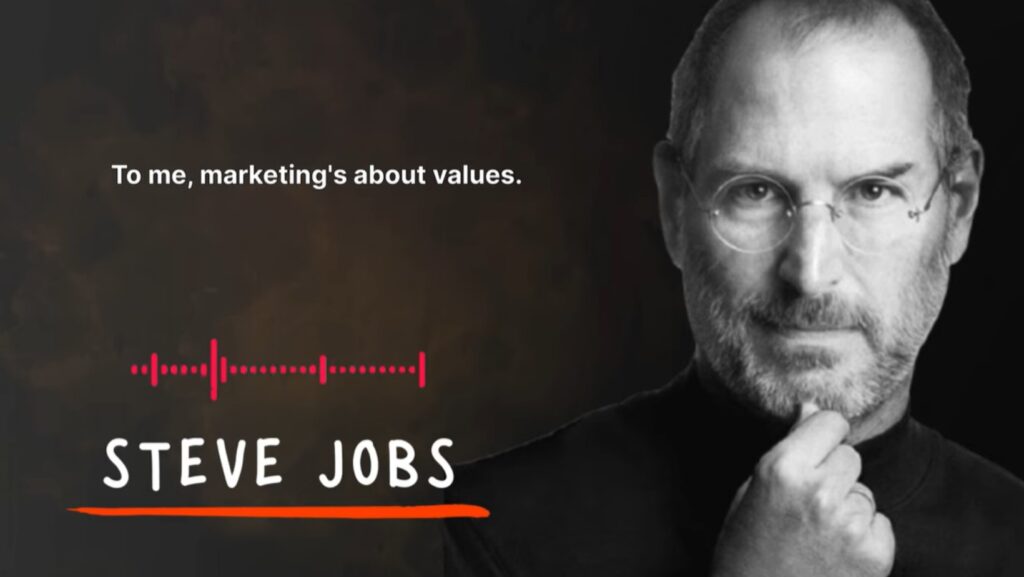
Marketing is About Values
Steve Jobs offered one of the clearest truths in marketing ever told… “People don’t remember products; they remember what you stand for.”
Long before “brand purpose” became a buzzword, Jobs understood that values are the real differentiator. His 1997 “Think Different” address was a masterclass in brand clarity. This post breaks down his timeless lessons with a practical framework to apply them to your own brand today.
Here’s the clearest audio I could find from Steve Jobs’ announcement of the Think Different campaign. Worth a listen. It became Apple’s advertising strategy for the next 20 years.
Key Message From Steve Jobs
“Marketing is ultimately about values. We live in a complicated, noisy world, and no company gets much time to make an impression. That’s why we must be crystal clear about what we want people to remember about us.
Apple is fortunate to be one of the world’s top global brands, alongside names like Nike, Disney, Coke, and Sony. But even the strongest brands need consistent care and investment to stay relevant. Apple’s brand had been neglected for years, and it was time to rebuild it.”
“The way forward wasn’t through technical specs, performance metrics, or comparisons to competitors. The dairy industry spent decades trying to convince people that milk was healthy, and it didn’t work. But when they launched “Got Milk?”, sales rose even though the campaign didn’t talk about the product at all. It focused on the absence of the product.”
“Nike is an even better example. They sell shoes. a commodity, yet their marketing never talks about air soles or features. Instead, they celebrate athletes and the spirit of athletic excellence. That’s what people connect with.
Apple had been spending heavily on advertising, but without impact. When the new leadership arrived, they reset everything, hired a new agency, and asked a simple question: Who is Apple, and what do we stand for?”
“Apple isn’t just a company that makes tools for getting work done, even though it does that well. At its core, Apple believes that people with passion can change the world. The company has always been inspired by people who think differently, the developers, creators, and customers who push boundaries in big and small ways.”
“The first major brand campaign in years needed to return to that core belief. The market had changed, Apple had changed, and the products and strategies had changed, but the values had not. Those values were the foundation.”
“The new campaign honours the people who have changed the world, some living, some gone, and reflects the idea that if they had used a computer, it would have been a Mac. The theme is simple: celebrating those who think differently and move the world forward. That spirit is the soul of Apple.”
5 Takeaways from his Message
Here is a breakdown of the five core ideas from his iconic “Think Different” announcement.
1. The world is noisy
Jobs opened by pointing out that people are overwhelmed with information. Brands only get a tiny moment to make an impression. If you try to say everything, people hear nothing.
2. Great brands stand for something
He used Nike as the example: Nike never talks about shoe features. They celebrate athletes, excellence, and human potential. People connect with beliefs, not specs.
3. Apple must communicate its core values
In 1997, Apple was struggling. Jobs said Apple needs to remind the world what it believes in. Apple’s values highlight creativity, innovation, challenging the status quo and empowering people who think differently. This becomes the foundation for the Think Different campaign.
4. Marketing is storytelling
Jobs argued that marketing is not about speeds, feeds, or features. It’s about telling a clear, emotional story about what the company stands for. People don’t buy products — they buy identity.
5. The “Think Different” campaign is the execution
He introduced the campaign as a way to reconnect Apple with its soul. The campaign celebrates Gandhi, Einstein, Picasso, Amelia Earhart, MLK, and other “crazy ones. Apple is for people who push the world forward.
Values Driven Brand Clarity Guide
The following helps you apply Steve Jobs’ principle that “Marketing is about Values.” Read each question in the heading, read the examples, and answer the question for your own brand.
What is your core belief?
Your core belief is the heartbeat of your brand, the idea you would defend even if your products disappeared tomorrow. It should be a statement about the world, your industry, or the people you serve. This belief becomes the lens through which every decision is made.
What makes a strong core belief?
- It’s bigger than your product
- It speaks to human truth, not features
It’s something your audience already feels but hasn’t articulated - It creates emotional alignment
Example: “We believe creativity should be accessible to everyone.”
Now, write a single sentence that captures the belief your brand exists to champion.
What is your brand purpose?
Your purpose explains why you exist beyond making money. It describes the transformation you help create for people, the before and after.
A strong purpose should…
- Focus on the customer, not the company
- Describe a change, not an activity
- Be simple enough to say in one breath
- Be inspiring enough to guide your team
Example: “We help people turn their ideas into reality with simple, powerful tools.”
Take some time to describe the transformation your brand enables. What changes because you exist?
What does your brand hero profile look like?
Your hero is the person your brand exists to empower. It’s more than a demographic; it’s a mindset. It reflects your values and signals who your brand is for.
A strong hero profile does these things well:
- Celebrates the qualities you want to amplify
- Helps you create targeted messaging
- Shapes your tone, visuals, and product decisions
- Makes your audience feel seen
Example: “We celebrate bold thinkers who challenge the status quo.”
What is the type of person who could champion your brand? What do they believe? What do they aspire to?
What’s your one message?
This is the single idea you want people to remember about you, even if they forget everything else. It’s your brand’s true north.
Here’s what a strong one‑message statement looks like.
- It’s short enough to fit on a billboard
- It’s emotionally resonant
- Reflects your core belief and purpose
- Guides all communication
Example: “We make innovation effortless.” Write the one sentence you want your audience to associate with your brand every time they see you.
What’s your expression plan?
Your expression plan defines how your brand shows up in the world visually, verbally, and behaviorally. It ensures your values are not just stated, but felt.
A strong expression plan includes:
- Visuals: colours, typography, imagery style
- Tone: how you speak, the emotional energy you project
- Actions: how you behave, what you prioritize, what you refuse to do
Example: “Our visuals are clean and bold. Our tone is confident but warm. Our actions prioritize simplicity.” Describe how your brand should look, sound, and act so people instantly recognize your values.
What’s your story?
Your story is the emotional proof of your values. It’s a simple narrative that shows your belief in action. People remember stories far more than statements.
A strong brand story…
- Is short and human
- Shows transformation
- Reflects your hero profile
- Demonstrates your core belief without explicitly stating it
Example: “A young designer launches her first product using our platform, turning a small idea into a global success.” Write a short, emotional story that illustrates the change your brand makes possible.
Download the Brand Clarity Guide
Inspired by Steve Jobs’ principle: “Marketing is about values.”
Use this guide to define the belief, purpose, and story that anchor your brand.
Download here: